

Every Saturday, the bucket elevator's drive chain gets a brush of grease. The rollers shine. The log says "lubricated". But wipe a joint and the rag comes away reddish-brown.
Consider this drive: The motor slide-base adjusters have run out of travel twice this year, and two pitches have been cut out. The plant standard says "replace chain at 3% elongation", so the planner is waiting for 3%.
The grease is going where the chain does not wear. The 3% was written for a different drive. Both faults have the same root: the chain is being treated as a length of steel to coat and measure, when it is a row of small bearings running on one particular sprocket.
The wear is inside the joint
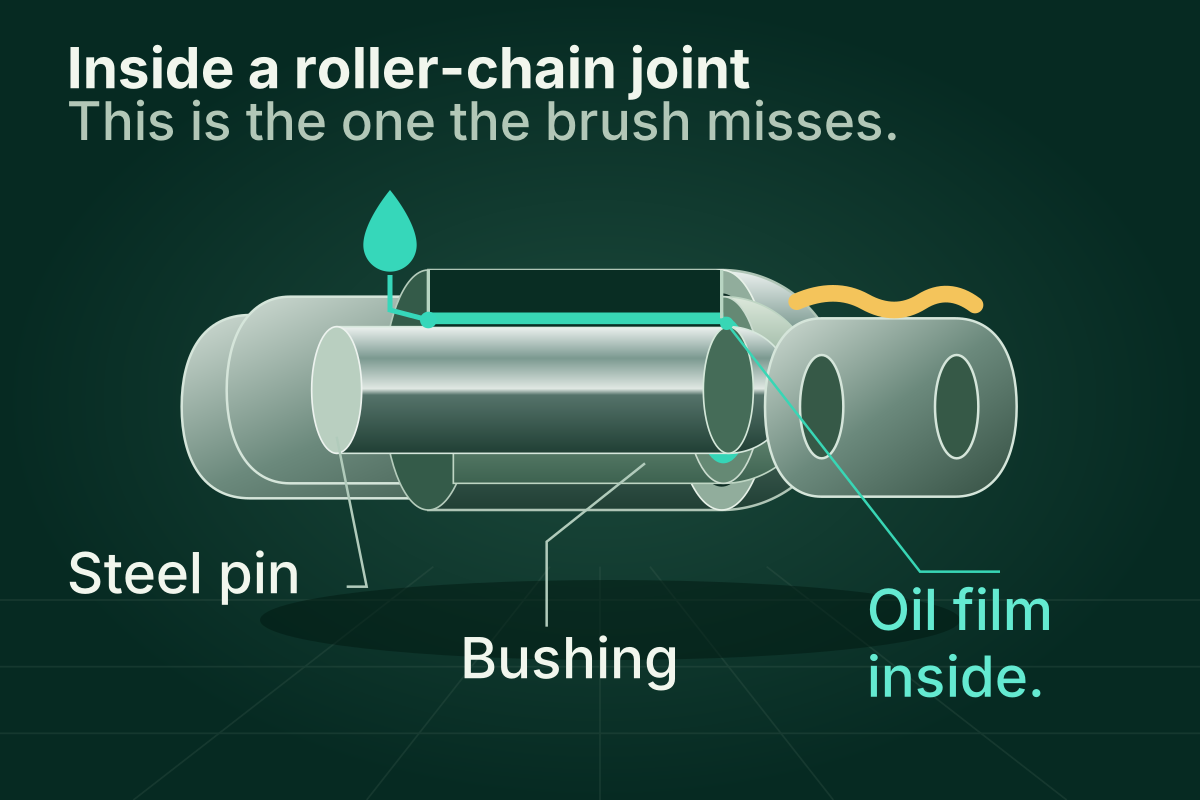
In each joint a pin carried by the outer plates turns inside a bushing carried by the inner plates, and a roller turns freely on the bushing. Each time a link runs on to a sprocket the joint bends through 360 degrees divided by the tooth count, 18 degrees on a 20-tooth sprocket, and straightens again as it leaves.
On the tight side of the drive, those movements happen under the full chain pull, and that is where the metal goes: chain elongation is wear from friction between the pins and bushings. The plates are not yielding, and a chain that has genuinely stretched has been overloaded.
The pitch, the distance from one pin to the next, grows because metal has left the pin and the bushing bore. Spread over every joint, that wear shows up as length, and the take-up absorbs it until it cannot.
Follow the oil to the wear surface
The gap between the plates is the way in. The roller surface is not the destination.
The brush feeds the wrong part
The rollers are the only working part a brush can reach, and they normally need minimal lubrication. The joint itself is closed off by the plates, and oil reaches the pin and bushing only through the clearance between the inner and outer plates.
Grease cannot make that journey.
Brushed on the outside, it seals the joint and will not work into it. Tsubaki's catalogue says it flatly: "Neither heavy oil nor grease is suitable." So a greased chain can run dry inside while looking wet outside.
Put the oil between the plates
What the makers ask for is not elaborate: a clean, non-detergent petroleum oil, as viscous as will still flow between the plates, typically ISO VG 32 to 220 by temperature and chain size, fed into the gap between inner and outer plates on the slack span. None of them puts it on the rollers.
How it gets there depends on speed: a brush or oil can about every eight running hours on a slow drive, a drip feed at 5 to 20 drops per minute per strand as speed rises, then an oil bath, and a pumped stream at high speed.
The Saturday brush fails on all three counts: wrong lubricant, wrong place, and an interval twenty times too long for a drive that runs round the clock.
Grease does have a proper place. Conveyor chain built for grease-gun lubrication has cross-drilled pins and bushings and a nipple on each pin end, which puts the grease inside the joint rather than on it.
The same wear climbs higher on a bigger sprocket
A worn chain has a longer pitch, but the sprocket was cut for the nominal one, so the chain seats on a slightly larger circle and every roller sits higher on its tooth. The top of a tooth can guide a roller but cannot carry the pull, so the chain "creeps up on the sprocket teeth until it starts jumping".
How far it climbs depends on the tooth count, and the arithmetic fits on one line. For a sprocket of N teeth, the pitch circle diameter is the chain pitch p divided by sin(180°/N). Grow the pitch by a fraction e and the seating circle grows by the same fraction, so the rollers rise by p × e / (2 sin(180°/N)).
On a 20-tooth sprocket of 25.4 mm pitch, 2% wear lifts the rollers about 1.6 mm; on a 100-tooth sprocket it lifts them about 8.1 mm, half a roller diameter. That is geometry, not a measurement: it seats every roller on one larger circle, while a real chain climbs the flanks progressively and loads a few teeth at a time.
The tendency to ride up scales the same way, which is why the big driven sprocket on the elevator is the one that decides.
Same wear. A much higher climb.
At 2% elongation, the 100-tooth sprocket lifts the chain about five times as far as the 20-tooth sprocket.
Where the makers draw the line
The makers' limits for standard roller chain run from under 1% to 3%, and each is right for the drive it describes. Renold's general limit is about 2%, falling to 1% once any sprocket has 90 teeth or more.
Tsubaki tabulates its limit against the large sprocket, from 1.5% at 60 teeth or fewer down to 0.8% at 101 to 110. Diamond allows 3% where the centres can be adjusted and 1.5% where they cannot. Rexnord gives 2.5 to 3% as an average, and iwis 3% as the general service limit.
The sprocket changes the limit
Read each maker's rule against the largest sprocket. A general 3% rule is not a safe substitute.
Run those rules through the same arithmetic and a pattern appears. Renold's 200/N per cent, the elongation the largest sprocket of N teeth can accommodate, is a rise of about a third of a pitch at any tooth count: 8 mm on 25.4 mm chain, the most a sprocket can carry before the chain rides up and jumps.
The replacement limits for big sprockets sit about half as high, a sixth of a pitch: 3 to 4 mm on Tsubaki's table, 3.6 to 4.6 mm on Renold's 1% rule. The numbers do not conflict; each maker is choosing how far up the tooth a roller may go. That reading is mine; none of them publishes the derivation.
One limit for each drive
On the elevator, look at the big sprocket first: rollers riding high near the tips of the teeth are reason enough to replace the chain without waiting for a reading. Then give every chain drive on the route one line like this one.
| Record | Elevator drive |
|---|---|
| Chain | 25.4 mm pitch, maker named |
| Sprockets | 20-tooth driver, 100-tooth driven |
| Centres | Adjustable, little travel left |
| Lubrication | Oil into the plate gaps on the slack span: every eight running hours, or a drip feed |
| Limit | 1%: Renold's rule for 90 teeth or more, Tsubaki's table for 81 to 100 |
| Readings | Twelve pitches, taut: every 500 running hours, 200 under shock, and at 100 hours on new chain |
| Replace | The whole chain, when twelve pitches measure 307.8 mm against 304.8 mm new |
Then measure it the same way every time:
- Under tension, with the strand pulled straight. Over twelve pitches 1% and 3% are only 6 mm apart, and slack hides the difference.
- Over at least four pitches, at several places, and at the same places every time.
- As a percentage of the new length, pitches times pitch: measured minus new, divided by new. A steel rule or callipers will do.
- On the record, so the trend sets the replacement date. Tsubaki's wear gauge marks 0.7% as the time to start planning.
- With the sprockets checked too: a polished strip around the pitch circle is tooth wear, and new chain on worn teeth wears fast.
For the elevator drive, the reading cannot wait. With two pitches already cut out and the adjusters nearly out of travel again, the chain is almost certainly past 1%. Measure twelve pitches today, and pull one connecting link to see what the pins have been running in.
At 307.8 mm or more, replace the whole chain, and check both sprockets' teeth before the new chain goes on. Then two jobs: move the oil to the plate edges and the interval to eight hours or a drip feed, and give the drive a limit that belongs to its 100-tooth sprocket.
When the new chain reaches that limit, the date will be on the record before the adjusters run out again.
Bring one chain drive's record to VAS
With the chain size, both tooth counts, the adjustment left and the current lubrication task, VAS can write a lubrication procedure and a measured replacement limit for that drive, and carry the method across the route.
Sources and method
The roller-rise figures and the twelve-pitch lengths are calculated from sprocket geometry and Renold's percentage formula, using the equations in the text, and the elevator drive is a worked example rather than a site record. The sources set out each maker's own lubrication and wear guidance; the article adopts no single maker's limit as a universal rule.
- Diamond Chain Maintenance Guide, Diamond Chain Company, document 11255_201903: lubrication, inspection and elongation limits, pages 5 to 8.
- Roller Chain Wear Gauge Instructions, Diamond Chain Company: measuring a taut span; the 3% and 1.5% limits.
- The Complete Guide to Chain, U.S. Tsubaki: sprocket engagement and tooth jumping, page 28; lubrication, pages 86 and 87.
- Tsubaki General Catalog, roller chain lubrication, U.S. Tsubaki, page 80.
- Chain Wear Indicator Kit, U.S. Tsubaki Power Transmission, 2018.
- Drive chain FAQ, Tsubakimoto Chain Co., in Japanese: questions 9, 10 and 30, on lubrication, the elongation limit by large-sprocket tooth count, and measurement.
- Sprockets, Renold: working pitch diameter and the 200/N accommodation rule.
- Transmission Chain Installation, Maintenance and Designer Guide, Renold Power Transmission, REN12, 2010: lubrication, measurement, wear limits and sprocket wear, pages I9, I10, I12, I20 and I25.
- Conveyor Chain Installation and Maintenance, Renold, REN16: grease-gun lubricated chain, page I12; wear measurement, page I13.
- Properly Lubricated Chains Last Longer, Renold: what the rollers need.
- Chain Elongation: Measuring for Prevention, Rexnord, EC7-001: wear as the cause of elongation, measuring under load, the 2.5 to 3.0% average.
- Wear Resistance Testing, iwis: the 3% service limit.
- ISO 606:2015, ISO; ASME B29.1-2011 (R2022), ASME.