

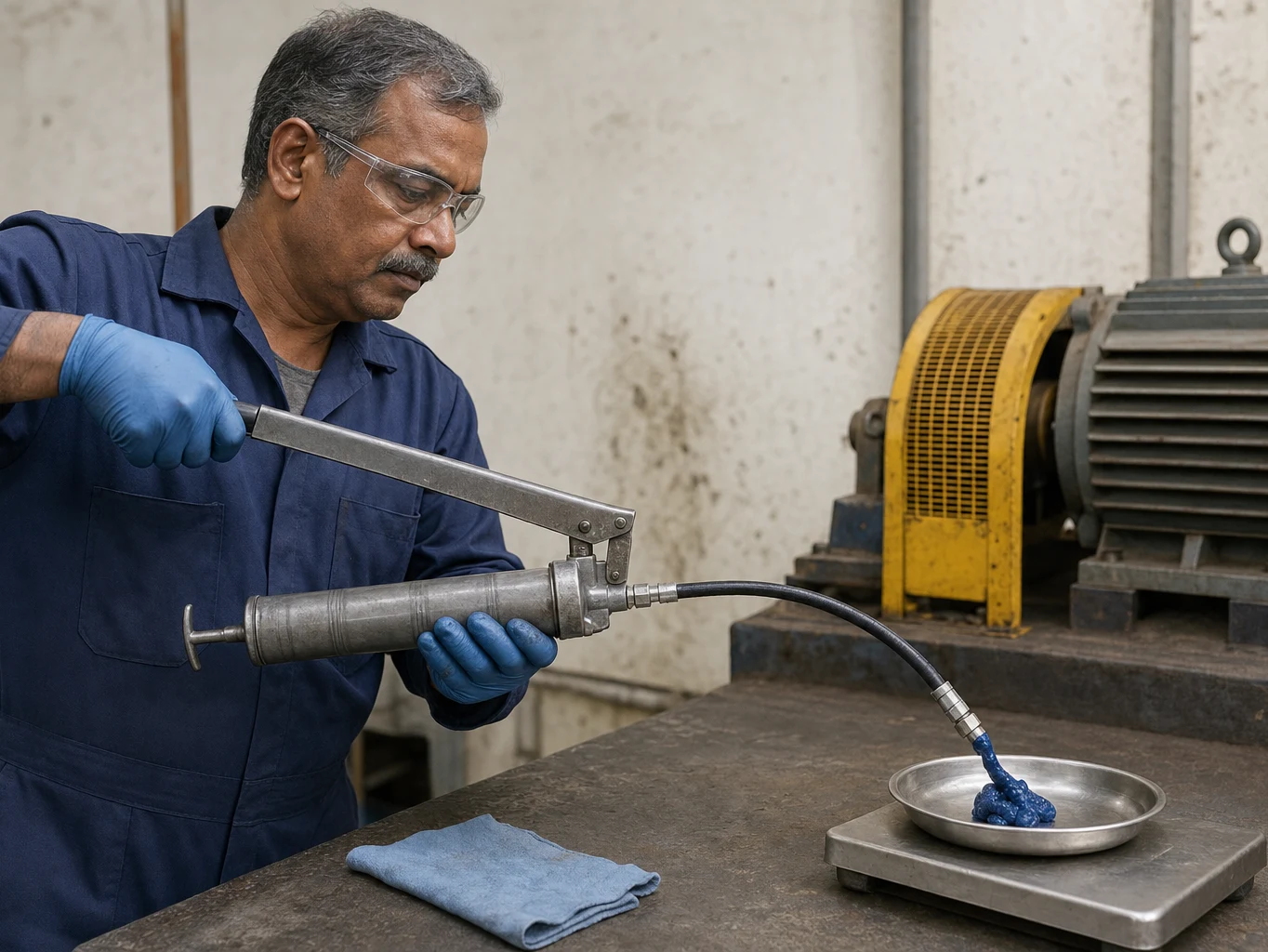
A stroke count records lever movement. The mass delivered by each movement depends on the gun, grease, hose, coupler, and technique.
Counting strokes without measuring output is like counting turns on a screw jack without knowing its thread pitch. The motion is known. The displacement is not.
Source: STLE, Regrease properly
STLE describes one gun that required 18 full strokes to deliver one ounce of grease. The same article gives two other examples at 10 and 28 strokes per ounce. At an equal stroke count, those two example guns would deliver grease in a ratio of 2.8 to 1. The figures illustrate possible variation, not the limits for every gun.
Before I would approve the route, I would want the replenishment requirement for the actual bearing and housing, the measured free-output mass of the assigned gun and delivery setup, and the machine-specific application method. Weighing output is easy. Deciding what that result means for the asset is the engineering work.
Confirm the bearing first
A fitting shows where grease can be introduced. It does not establish the grease, quantity, interval, or method. STLE notes that some motors carry fittings even when their bearings require no routine replenishment.
Check the current machine manual, bearing designation, housing arrangement, and lubrication plate where fitted. SKF publishes different replenishment factors for grease introduced from the side and through lubrication holes in a bearing ring.
Schaeffler limits replenishment when used grease cannot leave through housing space, an escape bore, or a grease valve. A generic bearing formula cannot settle the route by itself.
Record the approved replenishment mass in grams. State whether displaced grease is expected to leave the housing, where it should appear, and what happens after purge. These details separate what the asset requires from whatever tool is hanging on the lubrication cart.
Older plants deserve a hardware check. A motor may have been replaced, a bearing converted, or a fitting left after a design change. Compare the machine tag, manual revision, bearing designation, and housing arrangement. Resolve any mismatch before writing the stroke count.
Measure the complete gun setup
Fit the assigned hose and coupler, load the approved grease, and bleed the gun according to its manual. Begin the scale run only after delivery at the coupler is continuous. Trapped air invalidates the measurement.
Tare a clean cup on a scale suited to the expected mass. Deliver enough complete, consistent strokes for the collected grease to sit comfortably above the scale resolution. Ten strokes may be practical for many hand guns, but it is a test choice rather than an industry standard. Divide the collected mass by the number of full strokes, then repeat the run.
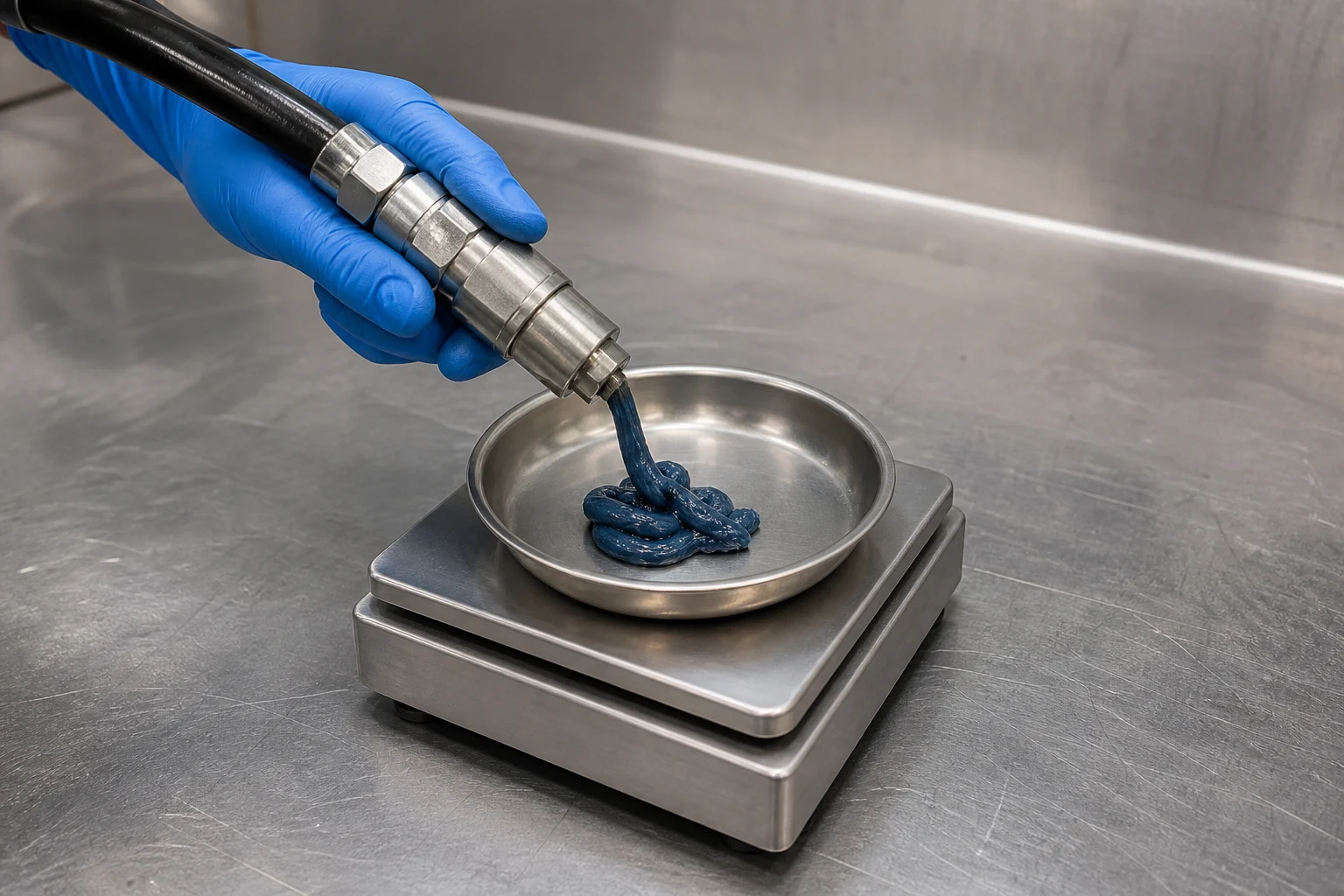
The bench check is like measuring pump displacement into an open container. It verifies free output under the test condition. It cannot reproduce the resistance at the machine. Leakage, a blocked fitting, trapped air, or an incomplete lever stroke can still reduce the mass entering the lubrication passage.
If repeated runs disagree beyond the plant’s approved tolerance, do not average the problem away. Check the prime, stroke technique, seals, hose, coupler, and visible leakage. A gun that cannot repeat its output is unsuitable for a quantitative route.
Record the gun ID, grease code, free-output grams per full stroke, test date, and verifier. Recheck after repairs, a grease change, a delivery-component change, loss of prime, or abnormal field behaviour.
Put the ID and date where the technician can read them. If the current gun record cannot be found, measure the gun again before using a stroke-based instruction.
Fifteen full strokes correspond to 12.3 g of measured free output. Use that instruction only if 12.3 g sits inside the approved dose range. Otherwise select a metered tool or change the delivery method. The rounding decision belongs in engineering, not beside the machine.
A hard handle is a pressure warning
A lever that suddenly goes hard behaves like a hydraulic jack at the end of its travel. More handle force raises pressure. It does not prove that grease is moving through the bearing.
Stop and inspect the flow path. The coupler may be misaligned, the fitting ball may be seized, the passage may contain hardened grease, or an outlet required by the procedure may be closed. Graco instructs users to stop when lubricant is not flowing because forcing it can create excessive backpressure and rupture a component.
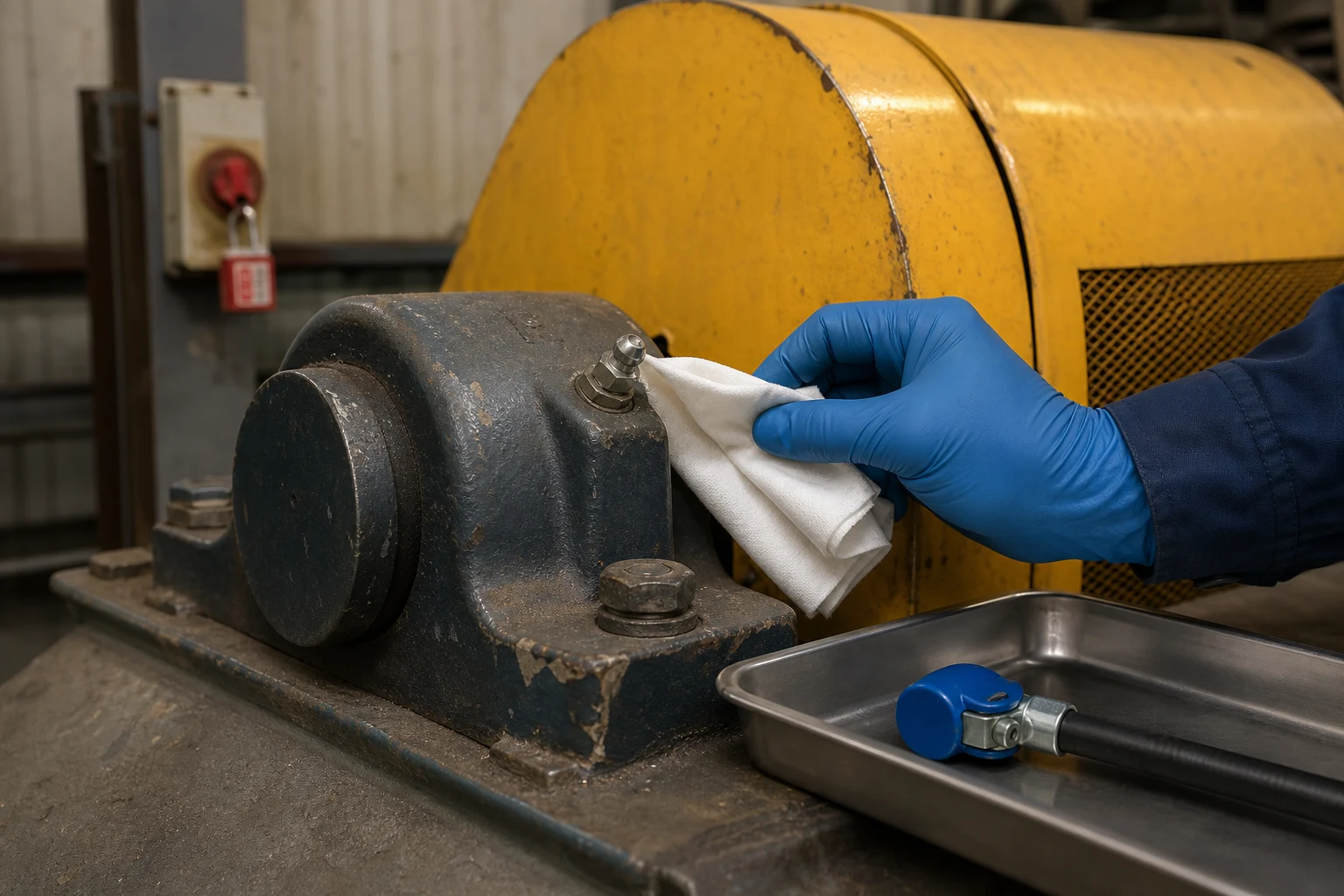
Cleaning is part of contamination control. STLE explains that dirt around the exposed ball can be driven into the bearing when the coupler is attached. Wipe the fitting before connection and protect the coupler between points.
Where the housing is designed to discharge displaced grease, pumping against a closed outlet resembles dead-heading a positive-displacement pump. Pressure rises because the volume has nowhere to go. Restore the approved path instead of leaning harder on the handle.
High-pressure grease can penetrate skin. Never use a hand, glove, or rag to find or stop a leak. Relieve pressure by the equipment manufacturer’s procedure before inspecting a hose, coupler, or fitting. A suspected injection injury requires immediate medical treatment.
Response to abnormal conditions
| What the technician finds | Required response |
|---|---|
| The handle becomes unusually hard | Stop pumping. Relieve pressure by the approved method, then inspect the coupler, fitting, passage, and any required outlet. |
| Grease leaks at the coupler | Stop. Treat the quantity delivered during the leaking stroke as unknown. Correct and verify the connection, then follow the asset-specific recovery or restart instruction. Do not add a replacement stroke unless that instruction requires it. |
| Grease appears somewhere unexpected | Stop if the procedure does not call for purge there. If purge is expected, follow its stated amount, duration, and inspection criteria. |
| Temperature or noise leaves its approved range | Record the change and follow the asset response criteria. Compare temperature with the OEM instruction and established baseline. |
Interpret heat, purge, and leakage
If excess grease cannot escape, churning can increase temperature and pressure, and grease may move past a seal or into an unintended space. Insufficient grease can also produce heat and wear.
A small purge may be normal in an arrangement designed for it, and ABB notes that a temporary temperature rise can follow relubrication. Heat, noise, or leakage alone cannot distinguish these conditions. Compare the observation with the OEM method, baseline condition, task history, housing design, and current gun record.
Prove the route at the machine
A correct calculation can still fail in the field. The fitting might be hidden behind a fixed obstruction. The coupler might not seat. The outlet instruction might not match the housing. The gun ID might be unreadable on shift. A field trial exposes these defects before the route is released.
Bearing relubrication work instruction
| Field | Required entry |
|---|---|
| Asset and point | Machine tag, bearing position, and exact fitting |
| Lubricant | Approved grease name or controlled plant code |
| Target mass | Replenishment mass in grams, approved range, and technical basis |
| Delivery tool | Gun ID, current free-output grams per full stroke, calibration date, hose, and coupler |
| Stroke instruction | Approved number of complete strokes and delivery rate |
| Application method | Access, cleaning, expected purge, relief path, and required machine state |
| Exceptions and record | Stop conditions, actual strokes, observations, technician, and date |
During the trial, ask the engineer who wrote the job to stay quiet. Let a qualified technician work from the page.
Mark every place where they ask a question, retrieve a value from memory, change the coupler, or interpret rising pressure without a written response. Revise the instruction and run it again.
Release the route when the technician can complete it safely from the written instruction and the record shows what was delivered. If measured output does not support the stroke count, fix the number.
If the fitting, outlet, machine state, or stop condition differs from the document, fix the job. Prove the method on one route before copying it elsewhere.
Put one grease route through a field trial
VAS can measure the assigned guns, review the asset requirement, and test the draft route with your technicians at the machine.Sources and application notes
Use the applicable OEM manual and site safety procedure for each machine. The references below explain the measurement and bearing-lubrication principles used here.
- STLE, Regrease properly
- SKF, Bearing Installation and Maintenance Guide
- SKF Lincoln, Model 1162 air-operated grease gun instructions
- Schaeffler, Rolling Bearing Lubrication
- Timken, Bearing Damage Analysis with Lubrication Reference Guide
- Graco, High-pressure grease dispenser instructions
- ABB, Low Voltage Ex Motor Manual: Lubrication Instructions