
Do not judge an oil room from the doorway. Pick one critical lubricant and follow it from the receiving record to the machine fill point.
A tidy room can fail that walk. The delivered product may be correct while an uncapped hose, an unverified shared pump, or a poorly identified container changes what reaches the machine. Chevron reports that oil can be handled several times during distribution before reaching equipment. Its guidance also says required cleanliness depends on the OEM specification, component tolerances, and system pressure.
Appearance is not the acceptance test. The real test is whether product identity and required condition can still be demonstrated at the fill point.
Map one route from delivery to application
Treat the route like the chain of custody for a laboratory sample. Each handoff must preserve identity and condition, and each person must be able to show what happened. A correct receiving result cannot protect an uncapped hose later. A dedicated cart cannot protect a dirty fill point.
Map the route on one sheet. At every handoff, record the source, destination, assigned equipment, required product identity, contamination control, and the evidence inspected. Include every temporary container, pump, hose, cart, filter, connection, and holding location used during the transfer.
New oil is unused oil. It may still miss a machine-specific particle or water limit unless that limit was specified and verified. When identity or condition is uncertain, stop the transfer and quarantine the material or affected equipment according to site procedure. Chevron's ISOCLEAN guidance describes why cleanliness requirements must be set for the application.
Set the acceptance plan before delivery
Match the delivery with the approved product name, technical specification, supplier, quantity, container type, destination, and purchase record. Inspect the label, closures, seals where fitted, damage, leakage, corrosion, and evidence of water exposure. If identity or condition is unclear, apply a visible quarantine status and prevent dispensing.
For a critical bulk delivery, define the acceptance plan before the tanker arrives. State the sample point, required line flush, bottle cleanliness, tests, limits, retained-sample method, authority to release the oil, and action for a failed or delayed result. Chevron's delivery technical bulletin calls for a retain taken from the initial flow at the delivery nozzle, labeled and logged, then kept for at least six months. If the required checks cannot be completed, quarantine the product or use the formal exception process required by site procedure.
Record the decision, not only the inspection. The receiving record should identify who released, quarantined, or rejected the lubricant and point to the sample result or exception that supports that decision.
Control exposure without defeating the tank design
Store packaged lubricants indoors in a clean, dry, sheltered area with controlled temperature wherever practicable. Packaged containers stay closed when not in use. Bulk tanks retain the designed vent, pressure-relief, and breather arrangement. Keep bulk-tank fill points sealed when not in use and fit the breather specified for the tank and lubricant. Separate accepted stock, quarantined material, open stock, and used lubricant so their status cannot be confused.
Where outdoor storage cannot be avoided, follow the lubricant and packaging supplier's instructions. Keep water away from closures, protect containers from direct sunlight and physical damage, and control temperature exposure. For steel drums stored horizontally, Chevron recommends placing the bungs at the three and nine o'clock positions in its storage guidance.
Use the approved product name or code on the storage position, dispensing equipment, transfer container, machine fill point, and work instruction. Colour can support recognition. It cannot replace text identification or the product record.
Check the equipment before opening the source
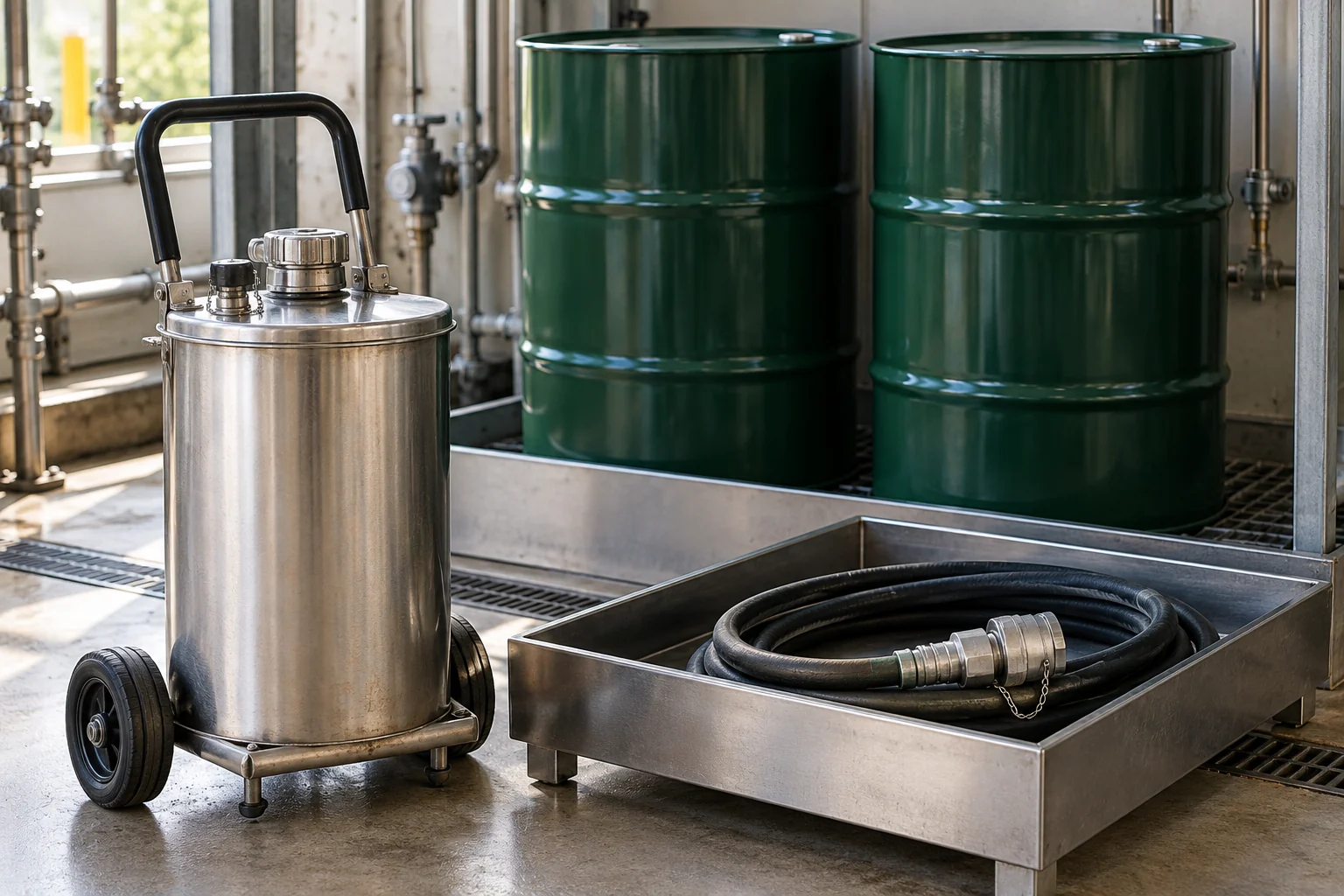
Before dispensing, compare the source label with the asset's approved lubricant code. Use the assigned pump, hose, and transfer container. Inspect their caps and connections before opening the source. If shared equipment is permitted, complete and record the approved changeover method before connecting it. Apply filtration only against an asset cleanliness target and a lubricant-specific process that has been technically verified.
Do not choose a filter from the ISO code alone. Chevron reports that unsuitable filtration can remove dispersed additives and impair foam control or water separation in some formulations. Define the filter medium, efficiency, temperature, flow, number of passes, and post-filtration acceptance checks with the lubricant supplier before standardizing the process. The mechanism and examples are set out in Chevron's filtration technical bulletin.
If an uncapped nozzle or coupling touches the floor: Stop the transfer and protect the open hose. Remove the affected component and clean, flush, or replace it according to the approved procedure. A surface wipe alone does not verify internal cleanliness.
Protect the final connection
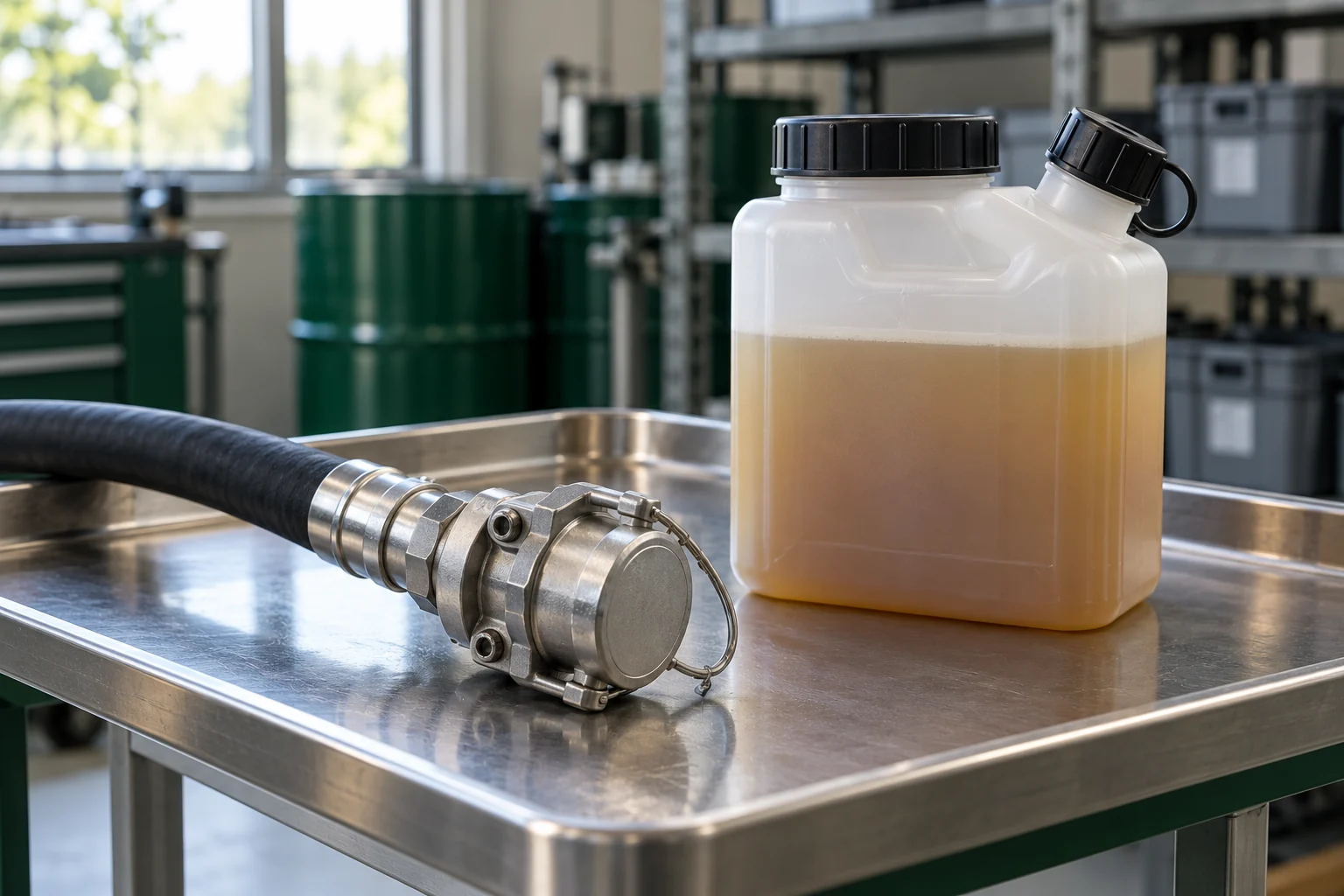
Confirm the asset, fill point, approved product, quantity, and required machine state before opening the machine. Inspect and clean the connection area by the approved method. Keep caps, plugs, hose ends, and nozzles protected throughout the task.
Do not place a hose end or nozzle on a platform, machine casing, or floor and then connect it to the asset. Use an approved closed transfer connection where the machine is designed for one. After filling, replace the fill cap and leave the reservoir isolated from ambient contamination except through its specified vent, breather, or other designed pressure-protection path.
Record the source product, quantity, point, date, person, and relevant observation. If delivered cleanliness is a specified requirement, use the approved sample point and method, then compare the result with the machine requirement.
Record what the route proves
Use the table below to prepare the walk with the people who receive, store, transfer, and apply the lubricant. In the working record, compare each requirement with what happens in the field and note the evidence inspected. Give each handoff one of three statuses: Meets requirement, Does not meet requirement, or Not verified. Not verified is not a pass.
| Handoff | Requirement | Evidence to inspect | Response to a failure |
|---|---|---|---|
| Receiving | The approved product, specification, quantity, destination, container condition, and acceptance plan agree. | Delivery record, label, closure condition, inspection record, and any required sample result. | Quarantine the material until the identity and acceptance decision are resolved. |
| Storage | Product identity remains clear. Accepted, quarantined, open, and used stock cannot be confused. Openings and engineered vent paths remain controlled. | Location record, labels, closure condition, tank vent or breather arrangement, inventory status, and housekeeping at the container. | Contain exposure, correct the status or identification, and inspect affected equipment or stock. |
| Dispensing and transfer | The assigned pump, hose, container, filter, and connection method match the source and destination. | Equipment assignment, caps, sealing faces, changeover record, filter specification, and condition of the transfer path. | Stop the transfer. Clean, flush, or replace affected equipment under the approved procedure. |
| Machine fill point | The asset, fill point, lubricant, quantity, machine state, and connection method match the current work instruction. | Asset label, work instruction, fill-point condition, task record, and any post-transfer sample or observation. | Isolate the error path, assess the machine risk, assign corrective work, and verify the next use. |
The working record should capture the observed condition, evidence, status, immediate action, owner, due date, and verification method. Do not total or average the results. A confirmed wrong-product path, open contamination path, or uncontrolled connection at a critical machine remains an action until it is contained and verified closed.
Observe the work before copying the method
Take the current receiving record and transfer kit to the machine with the person who normally performs the task. Ask them to identify the source product, select the assigned equipment, protect each opening, make the transfer, close the fill point, and complete the record.
Note every place where they must rely on memory, interpret an abbreviation, place a hose end, improvise a changeover, or proceed without proof of product assignment. Correct that route and observe it again before copying the method to other lubricants.
Track failures that require action: unidentified containers, open hoses or couplings, overdue quarantine decisions, unverified shared equipment, contaminated fill points, and results outside the asset limit. Verify the correction at the next use.
Where the walk exposes gaps in program ownership, asset requirements, or field procedures, connect the work to Lubrication Program Development. If the plant needs sustained onsite execution, review Lube and Coolant Management.
Trace one lubricant route with VAS
Bring the receiving record, transfer equipment, route instruction, and machine requirement. We will walk the path with your team and show where product identity or lubricant condition can be lost.
Sources and method
This article applies the cited standard and Chevron technical guidance to a plant route audit. Plant requirements must also reflect current OEM instructions, lubricant supplier advice, site EHS procedures, warranty conditions, and applicable regulations.