
Lubrication field checks
The Divider Cycled. Did the Bearing Get Any Grease?
A split line can leak with every stroke of the divider. Here’s what five cycles and a small collection cup can tell the next shift.

In this article
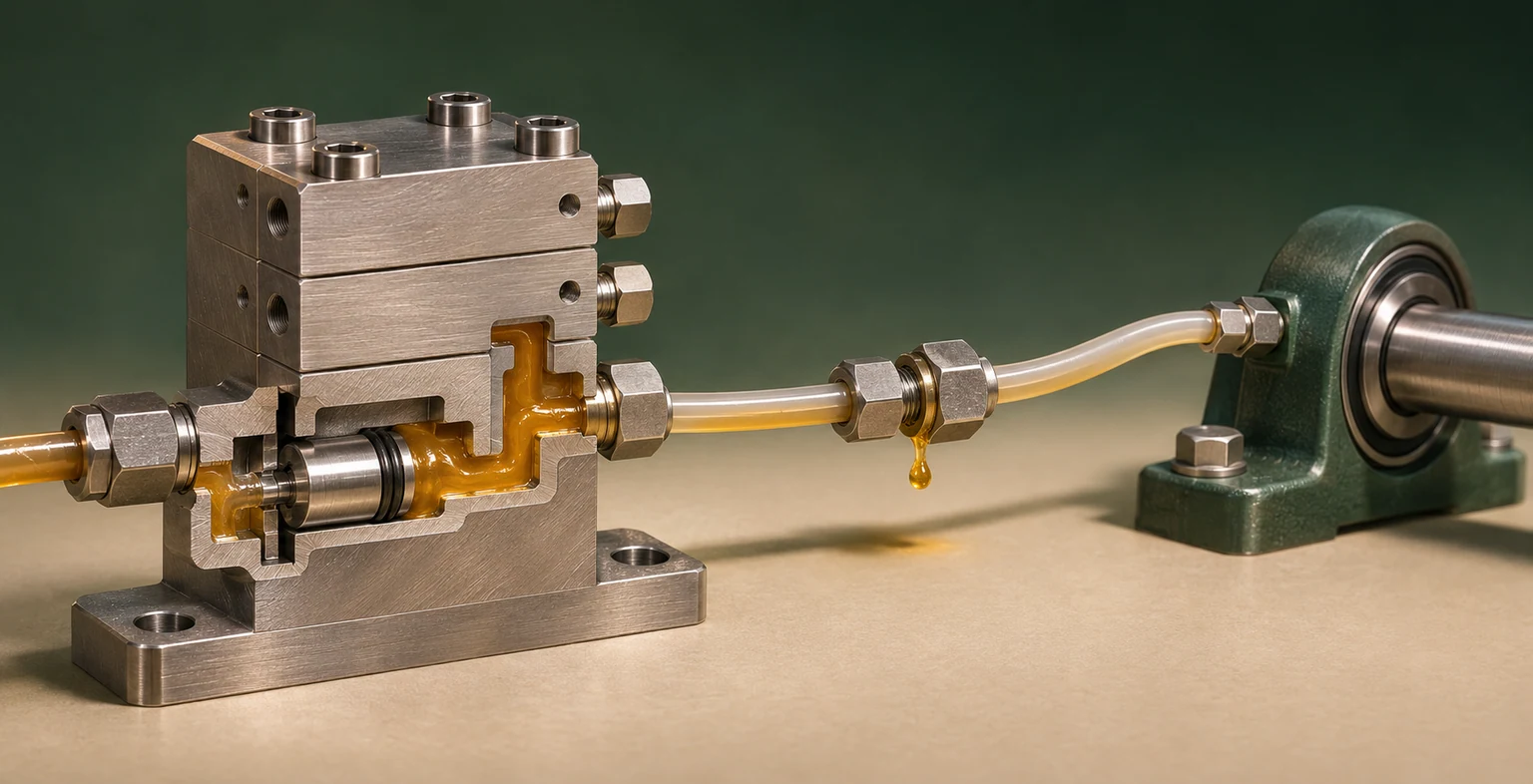
Suppose you find grease under a pipe union and a perfectly ordinary cycle count on the controller. Which do you believe? Both. The small piston inside the divider can move every time it should while the grease it meters takes the shortest way out through the leak.
Once the union is repaired, the grease on the floor is easy to wipe away. The harder question to answer at handover is how much made it all the way to the bearing.
Where the signal comes from
Find the detector on the lubrication drawing. In a progressive divider, the pistons take turns moving as grease passes through. Depending on the model, a switch picks up the movement of an indicator pin or a detector senses the piston itself. Either way, the instrument is watching something move inside the divider. The bearing may be several metres of tubing away.
Start with the outlet feeding the repair and follow its line. Say the drawing identifies that outlet as B3. Write down the bearing it serves as well. On a busy manifold, a good reading from the neighbouring line would be an easy way to sign off the wrong repair.
If the piston has stopped cycling, the fault search takes a different turn. SKF’s KFG instructions list a blocked feeder, damaged lines, a faulty detector and insufficient lubricant among the causes of a missing signal. The controller alone cannot tell you which one to chase.
What reaches the cup?
Take a worked example. B3 is set to deliver 0.20 cm³ per complete cycle. Following the equipment maker’s isolation, pressure-release and collection procedure, a technician measures discharge from the primed line at the disconnected bearing end.
| Five-cycle collection | Result |
|---|---|
| Expected at the line end | 5 × 0.20 cm³ = 1.00 cm³ |
| Measured in the cup | 0.96 cm³ |
| Average delivery | 0.192 cm³ per cycle |
- Five-cycle collection
- Expected at the line end
- Result
- 5 × 0.20 cm³ = 1.00 cm³
- Five-cycle collection
- Measured in the cup
- Result
- 0.96 cm³
- Five-cycle collection
- Average delivery
- Result
- 0.192 cm³ per cycle
Is 0.96 close enough? First check whether the collection method can distinguish a difference of 0.04 cm³. Then look up the tolerance for that metering device. Those two details decide what you can say about the shortfall. The grease in the cup does tell you that the repaired line delivered grease to its open end.

The last connection
The cup never sees the resistance of the bearing inlet. A restriction there can still matter once the fitting is back in place. After reconnection, use the maker’s specified check for delivery at the installed bearing point and check the joint for leakage.
Midway through the job, a useful handover would read, “B3 to drive-end bearing. Five cycles, 0.96 cm³ at the open line end. Bearing inlet still to check.” The person picking up the work knows exactly where to start. When the bearing-point check is complete, add what was observed there and who verified it.
References
- SKF, Progressive metering devices, section 3.3 (PDF). How an indicator pin, proximity switch or piston detector monitors divider movement.
- SKF, KFG pump operating instructions, sections 15.1.6 and 15.1.7 (PDF). Bearing and line inspections, plus the fault list for a missing piston signal.